Keratoconus

Keratoconus
At Lexington Eye Associates, we emphasize excellence in eye care.
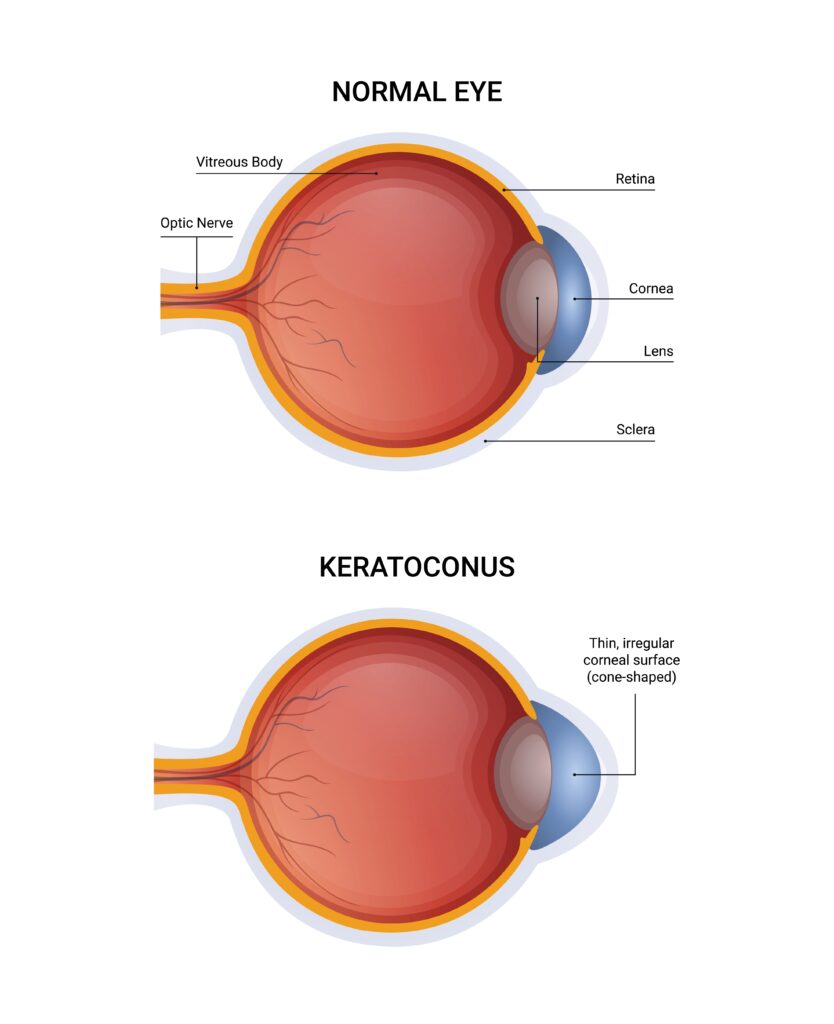
Keratoconus is a progressive corneal disorder that affects patients’ vision. It is a relatively common condition in which there is an abnormality in the shape of the cornea. The normal cornea consists of a round, dome-like shape that is regular and symmetric throughout. In patients with keratoconus, the cornea takes on an irregular shape that causes part of the dome to become thin and develop a cone-like bulge. This results in distortion of the cornea that blurs vision and can make certain daily activities difficult due to poor vision.
Clinical Symptoms
Although the disease is present in both eyes, symptoms are often asymmetric between the two eyes. The disease, and thus symptoms, usually start to occur in patients in their late teens and twenties. Complaints typically consist of blurring of vision, distortion of vision, or sensitivity to light and glare. As the disease progresses, patients may notice worsening vision, rapid changes in their prescriptions, or an inability to wear contact lenses.
Treatment
In the early stages of keratoconus, vision can often be corrected with eyeglasses or soft contact lenses. As the cornea becomes more irregular, specialized contact lenses—including rigid gas permeable (RGP), hybrid, and scleral lenses—may provide clearer vision.
For patients with progressive keratoconus, corneal collagen cross-linking (CXL) is the primary treatment used to slow or stop further progression of the disease. CXL strengthens the cornea by using riboflavin (vitamin B2) and ultraviolet-A (UV-A) light to increase the bonds between collagen fibers. The FDA first approved corneal cross-linking for progressive keratoconus in 2016. In 2025, the FDA also approved an epithelium-on CXL treatment for adults and children age 13 and older. Your ophthalmologist will determine which treatment approach is appropriate based on your age, corneal thickness, disease progression, and other factors.
CXL is designed primarily to stabilize the cornea and prevent further progression. It does not necessarily eliminate the need for glasses or contact lenses, and patients may continue to need vision correction following treatment.
If keratoconus becomes advanced and good vision can no longer be achieved with glasses or contact lenses, or if contact lenses cannot be tolerated, surgical options may be considered. Depending on the individual patient, these may include corneal ring segments or a corneal transplant, such as deep anterior lamellar keratoplasty (DALK) or penetrating keratoplasty.
Patients with keratoconus should avoid rubbing their eyes, as repeated eye rubbing is associated with keratoconus progression. Treating underlying eye allergies and other conditions that cause itching can also help reduce the urge to rub the eyes.
Because keratoconus causes thinning and weakening of the cornea, patients with keratoconus are generally not candidates for LASIK or other corneal laser vision correction procedures. These procedures can further weaken an already compromised cornea and may increase the risk of corneal ectasia.